Un Tempo c'era la parola, poi i libri, i Sapienti nascondevano conoscenza e messaggi all'interno dei loro Libri. Nell'Era contemporanea oltre ai Libri, c'è anche la nuova Arte, il cinema. Nei loro lungometraggi registi, sceneggiatori e talvolta, attori, divulgano messaggi e conoscenze. Qui, brevi analisi di quei libri e di quei film che possono raccontare qualcosa.
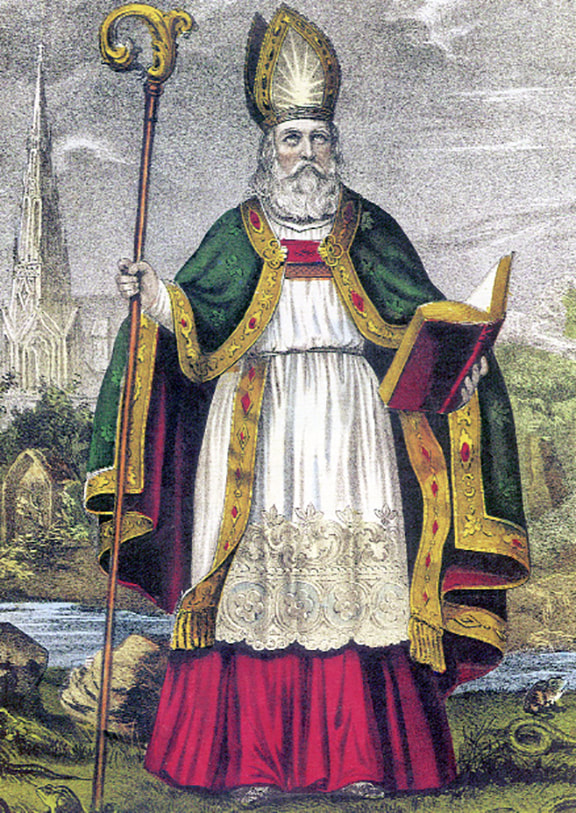
Image above of 5th century man in 18th century bishop costume...
Saint Patrick's Day is an Irish bank and public holiday held on March 17th every year, relating to Saint Patrick who made all the Irish become Catholic CE 400 by using shamrocks... so we are told… but historians agree that the man who did this great conversion by bringing the Catholic religion to Ireland was called Palladius (who was married with children), he was most definitely not named Patrick, nor was he Irish and there were no snakes in Ireland for either he or Patrick to eradicate and neither he or Patrick ever mentions shamrocks. As the current calendar is less than 250 years in use it cannot be used to establish dates in the early medieval period so it is highly unlikely that he died on March 17th 460ad. So, what is his true story?
” Extremely little. The total of evidence we have for the
druids could probably fit on a few pages. All that comes down to us
directly are a handful of references by Roman authors, non of which sets
out to describe the druids, the mentions are all incidental.” –
Redditor
“We don’t know what druids wore. We don’t know whether men and women
worshipped together. We don’t know what druids believed or taught. We
don’t know what druids said or did during their worship. We don’t know
what their cosmology was. We don’t know how they performed
divination. We don’t know what their astrological systems were like.”
– Francine Nicholson, M.A.
That we have ‘no idea’ about these things is Balderdash.
How Much About Druids Can Be Known?
We have no reason to believe that the development of Druids, proto-druids, and culture surrounding them was subject to a different
set of rules than the priests of their sister cultures. Because we have
no such evidence, we are left to conclude that the druids and things
about them, developed the same way as other Indo-European priests,
lawmakers, and sacrifices.
Quite the contrary is true in actuality. We know through the study of linguistics, archeology, and anthropology that the Proto-Indo-Europeans and their descendants migrated core ideas of pagan ideology and practice throughout Europe and India.
The CR faq addresses this on their page about what the druid believed:
“It is possible that the druids had restrictions on
writing down anything that was considered sacred. However, some of the
Celtic peoples did leave records of their beliefs and practices, and
some of these traditions have survived, in a modified form, up to the
present day.”
The various Indo-European cultures moved into new areas and blended
with the Old European pre-Indo-European customs and faiths. Because pastoralherdsmen clashed with agrarianfarmers, these beliefs took on mutations, new ideas, new flavors, and new characters.
What can we learn from Christianization?
Add to all of this; these cultures underwent a period of slow
Christianization. However, their Christianization bespeaks of their similarities in proto-Indo-European paganism. Our
ancestors accepted Catholicism so readily in these cultures with such
high numbers, and that a single ritual format worked for all of them is
less of an indictment on Catholic culture theft and more a celebrated
understanding of a continuation of pagan practice in European religion.
Taking Caution
Where we take caution and care is in dissecting worldview in
information which has come down to us. So far, we can draw from the
first-hand accounts of customs of our recent Celtic ancestors from
things like the Carmina Gadelica, the IrishRite and CelticRites from the order of liturgies from treating the sick, St. Galls Incantations, and Danaher’s “The Year in Ireland,” among other works. We take these things and the myths and filter it in reverse through a pagan worldview built out of an exhaustive comparative study of pre-Christian Indo-European pagan religions.
Triplicities of gods in prayers, for example, stay, but we then have
to replace Father, Son, Holy Spirit in prayers. But that isn’t enough,
we then have to rewrite the prayer to be in a Celtic pagan worldview,
triangulating your good guesses from other facts. When we do this, we
define a safe region with which to mix the elements of practice and
belief around to make it work and see how the psyche performs.
Experimenting
If we do certain ascetic practices and experience the Inspiration
Which Illuminates, and all the symptoms of that experience match even
what Christians wrote, you realize that such things aren’t as altered as
you thought, and maybe we don’t give the Christians enough credit here,
and too much there.
This region that exists between all the facts and the best guesses
turns out to be a place in your religion which everything fits, lines
up, and is undoubtedly druidic and Celtic, and by all measures,
undeniably recognizable by our ancestors. Anybody who celebrates the
Goose Harvest in Ireland understands the Russian pagans who sacrifice
water foul on the same day in sacred groves on the borders of Baltic and
Slavic Europe.
Where Does Information About the Druids Exist?
We can look at similarities in the
clergy of other Indo-European cultures and rebuild Celtic belief, give
it a workable skeleton which renders a practice out of the
reconstructionist approach and methodology that is whole. It is not only
possible to have a ballpark knowledge of clothing, worship, cosmology,
and cosmogony, and we know they divined by sacrifice like everyone else.
The Old Religion nearly rebuilds itself in the hands of great minds who
do the work and the due diligence. Roman and Vedic priests have nearly same taboos, which is just one fact among a myriad demonstrating there is an underlying ideology in Indo-European paganism and an underlying universal structure with the way the gods evolved through migrations from the Yamnaya culture → Corded Wares Culture → Urnfield Culture → Hallstatt Culture → Gaulish Culture → Irish Culture.
It is with the Corded Ware Culture that we have split-offs into
Germanic and Slavic paganism. These other cultures are what I call
‘Sister Cultures’ to the Celts. Through the writings contained in their
sister cultures, we’ve never lost anything. Instead, our ancestors distributed
the information, and we can garner enough data for a lifetime of study
and practice, certainly more than the troupe if ignorance about the
druids implies.
We look to works like “Druids: A Very Short Introduction” by Barry Cunliffe, and “A Brief History of the Druids” by Peter Beresford Ellis. We look to ClassicalTexts
by the Romans and Greeks while trying to clean the information of their
biases and the ongoings of the day(Like, for instance, that Rome ran
out of gold before they decided to plunder the offering hoards of the
Gauls). This information exists in manuscripts, wisdom tracts, myths and
recorded practices from the 1800s, books like Danaher’s, and the book
called “Irish Folkways” by E. Estyn Evans and the “Fairy Faith in Celtic Countries”
by W.Y. Evans-Wentz. We have the writings of the Greeks, Romans, and
Vedic pagans about their religions, and 20 & 21st century
Indo-Europeanist assessments of how those things relate to Celtic
paganism, for instance, the concept *swed-dhos, the universal Indo-European warrior ethic for the band of boon takers. And that scratches the surface.
In more ways than one, it is a blessing that the druids didn’t write
first-hand accounts because the pursuit of a workable system is all the
point of being a Celtic pagan.
Johnny Cash The man.. And I heard as it were the noise of thunder – E l’ho sentito come se fosse stato un rumore di tuono One of the four beasts saying come and see and I saw – Una delle quattro bestie dice “vieni e vedi” e io vidi
And behold a white horse – E tenevo un cavallo bianco There’s a man going around taking names – C’è un uomo che gira prendendo nomi And he decides who to free and who to blame – E decide chi liberare e chi incolpare Everybody won’t be treated all the same – Non saranno tutti trattati in modo uguale There’ll be a golden ladder reaching down – Ci sarà una scala d’oro che scende When the Man comes around – Quando l’uomo passa
The hairs on your arm will stand up – I peli sul tuo braccio si raddrizzeranno At the terror in each sip and in each sup – dal terrore in ogni sorso e in ogni sorso Will you partake of that last offered cup? – Condividerai quell' ultima offerta tazza ? Or disappear into the potter’s ground – O scomparirai nel pentolone nel pavimento When the Man comes around – Quando l’uomo passa
Hear the trumpets, hear the pipers – Senti le trombe, senti i pifferi One hundred million angels singing – Un milione di angeli stanno cantano Multitudes are marching to the big kettledrum – Le moltitudini stanno marciando verso il grande timpano Voices calling, voices crying – Voci che chiamano, voci che piangono Some are born and some are dying – Alcuni sono nati e altri stanno morendo It’s Alpha and Omega’s kingdom come – Sta arrivasndo il regno dell’Alfa e dell’Omega And the whirlwind is in the thorn tree – E il turbine è nell’albero di spine The virgins are all trimming their wicks – Le vergini ornano i loro stoppini (candele) The whirlwind is in the thorn tree – Il turbine è nell’albero di spine It’s hard for thee to kick against the pricks – Ti è dura dare calci ai tuoi rimorsi Till Armageddon no shalam, no shalom – Finchè l’armageddon non saluta, non da pace Then the father hen will call his chickens home – Allora il padre chiamerà i polli a casa The wise man will bow down before the throne – L’uomo saggio si inchinerà davanti al trono And at His feet they’ll cast their golden crowns – E ai suoi piedi getteranno le loro dorate corone When the Man comes around – Quando l’uomo passa
Whoever is unjust let him be unjust still – Chiunque è ingiusto, lascialo essere ingiusto Whoever is righteous let him be righteous still – Chiunque è giusto lascialo essere giusto Whoever is filthy let him be filthy still – Chi è sporco lascia che che lo rimanga Listen to the words long written down – Ascolta le parole a lungo scritte When the Man comes around – Quando l’uomo passa
Hear the trumpets, hear the pipers – Sento le trombe, sento i pifferi One hundred million angels singing – Un milione di angeli stanno cantano Multitudes are marching to the big kettledrum – Moltitudini stanno marciando verso il grande timpano Voices calling, voices crying – Voci chiamano, voci piangono Some are born and some are dying – Alcuni sono nati, altri morendo It’s Alpha and Omega’s kingdom come – Arriva il regno dell’Alfa e dell’Omega And the whirlwind is in the thorn tree – E il turbine è nell’albero di spine The virgins are all trimming their wicks – Le vergini ornano i loro stoppini (candele) The whirlwind is in the thorn tree – Il turbine è nell’albero di spine It’s hard for thee to kick against the pricks – Ti è dura dare calci ai tuoi rimorsi In measured hundredweight and penney pound – Misurati quintali e centesimo di libbra When the Man comes around – Quando l’uomo passa
And I heard a voice in the midst of the four beasts – E udii una voce di mezzo alle quattro belve And I looked and behold, a pale horse – E ho guardato e osservato, un pallido cavallo And his name that sat on him was Death – E il nome che sedeva su di lui era "Morte" And Hell followed with him – E con lui seguì l’inferno